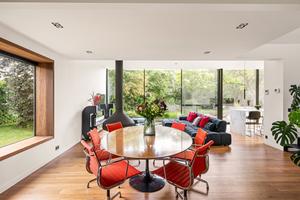
Uncertain interest rates accelerate the shift towards move-in-ready homes
Buy, build or renovate? The combination of rising construction costs, higher interest rates and geopolitical uncertainty is fundamentally changing the behaviour of prospective buyers. At Found & Baker, we are seeing increasing demand for move-in-ready homes, while renovation projects are becoming less attractive.
Construction costs have risen by almost 30% over the past five years. This increase put pressure on the construction and renovation market, although the impact was somewhat cushioned by low interest rates. Since the war between the US and Iran began at the end of February 2026, the situation has completely changed. Interest rates have risen, reaching a peak of 4.52% in August. How long-term lending rates will evolve is anyone’s guess.
After the pandemic, the housing market reached new heights in 2021. Loans were cheap, supply was limited and prices soared. Mortgage rates were around 1% at the time. With a monthly budget of €4,000, buyers could borrow around €250,000 more than they can today. We are now seeing greater caution in the renovation market and increased demand for move-in-ready homes.
The uncertain geopolitical context is influencing the evolution of interest rates, but even if rates fall, the effect will not be immediate. In recent years, buyers have become more cautious about purchasing homes dating from the 1980s, 1990s and early 2000s. Many of these properties are due for renovation. Without an adjustment in construction costs, renovating is becoming unaffordable. Whereas we used to assume an average renovation cost of €2,500 per square metre for a property in the higher-end segment, we are now looking at €3,500 per square metre or more, excluding VAT. For a 250-square-metre home, that represents an additional cost of €250,000.
Rapid evolution
A move-in-ready home offers certainty: as a buyer, you know what you are paying for. At Found & Baker, we are seeing higher interest rates once again driving a shift in demand. The gap between purchasing power based on wealth and purchasing power based on income continues to widen. For the same monthly repayment amount, people can borrow less. Even for dual-income households with above-average earnings, the impact is significant.
At the same time, prices for move-in-ready homes continue to rise. Scarcity is increasing. As a result, we are also seeing asking prices surge in municipalities beyond the traditionally sought-after locations, such as Knokke-Heist, Sint-Martens-Latem, Tervuren and Park Den Brandt.
Another interesting development is the shift towards the high-end rental market: our rental market has never been stronger. Tenants with a stable income and strong repayment capacity are temporarily finding it easier to rent a property in a better segment than the one they could afford to build or buy today.
The financial calculation is quickly made. What concerns us somewhat is the speed at which the market is changing. Price developments that used to take ten years are now occurring in less than three.
The Flemish government is encouraging the reduction of built-up public space, while at the same time imposing significant energy-efficiency requirements that demand substantial investment. In the current context, this creates a difficult balancing act. Should we scale back our construction ambitions and consider a rental model similar to that of the Netherlands? Should we structurally revise the VAT rate to make renovation more attractive?
For us, one thing is clear: action is needed. It is particularly difficult to predict where the market will be in a few months or a year. The question is whether postponing a home purchase is the right approach.